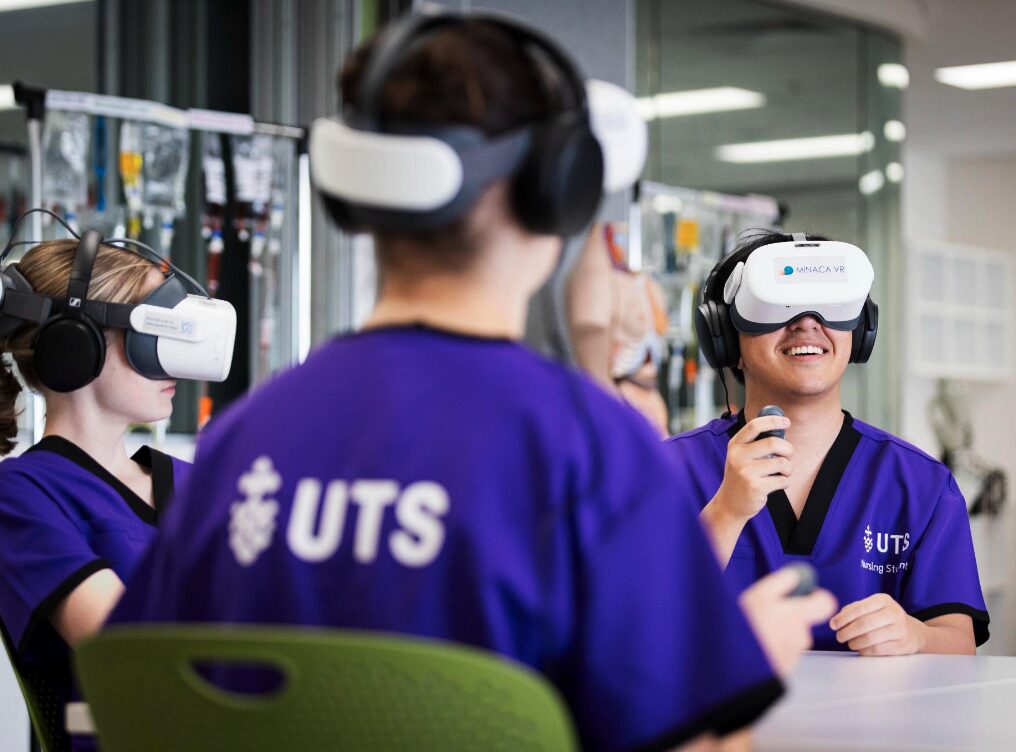
The University of Technology Sydney (UTS) has announced its plan to make immersive virtual reality (VR) training in aggression and violence prevention mandatory for all its first-year nursing students before they begin clinical placements.
The initiative comes as healthcare workers across Australia face rising incidents of violence. A recent survey of the NSW Nurses and Midwives Association* found 88% of nurses, midwives and carers have witnessed violence or aggression at work.
Developed in partnership with leading, Sydney-based immersive learning company Start Beyond and informed by work health & safety and psychosocial risk specialists, The Risk Collective, the program uses VR headsets to place students inside realistic healthcare situations where they must learn to recognise aggressive behaviours, make decisions under pressure and practise de-escalation techniques in a safe, virtual environment.
UTS says it will embed the training into its nursing curriculum from next year, ensuring every one of its 600 plus new nursing students has the opportunity to complete the program before entering a clinical setting. UTS’ decision follows a successful pilot in which 90% of participants said the simulation was useful in helping them identify early warning signs and take appropriate action to de-escalate and stay safe.
“We’ve seen enough evidence of violence against nurses to know we must give students practical strategies to recognise escalating situations and keep themselves safe before they encounter such threats in the real world,” said Professor Jacqui Pich, Deputy Head of School (Teaching and Learning) in the UTS School of Nursing & Midwifery.
“Traditional teaching methods can only go so far, whereas VR creates a much more immersive learning experience, while ensuring our students’ physical and psychological safety.”
Professor Pich said she hoped the program would help establish a new benchmark for nursing education.
“We know this is a gap in healthcare education and we would love to see other universities explore similar approaches because we all have a duty of care to prepare students as best we can for the environments they’ll be working in,” she said.
Clinical Academic Lead in the UTS School of Nursing & Midwifery, Lucy Rosenberg said students can find themselves exposed to challenging situations very early in their careers.
“While most placements are positive experiences, incidents involving aggression occur more often than we’d like,” she said.
“Students now have an opportunity to learn in a safe environment and understand both best-practice responses and the consequences of poor decisions. The immersive nature of VR makes it much closer to real life than traditional classroom role play. Students aren’t responding to a colleague pretending to be a patient. They feel like they’re actually in the situation.”
Start Beyond CEO, Angus Stevens, noted VR offered a unique opportunity to prepare healthcare workers for emotionally charged situations without exposing them to real-world risk.
“The power of VR is that it can make people feel something. When people feel something, they remember it. When they remember it, they learn from it,” he said.
Mr Stevens added that Start Beyond has seen similar transformative results across healthcare, retail and hospitality.
“Healthcare professionals often do their invaluable work in high-stress environments in which they are exposed to unpredictable situations that can escalate rapidly to become dangerous. Our training uses VR to recreate that complexity and emotional intensity in a safe environment where students can practise, make mistakes and build confidence.”
Founder & Principal Consultant at The Risk Collective, Amy Towers said the training scenarios were grounded in behavioural research and real-world workplace data.
“We analysed common patterns of aggressive behaviour across multiple sectors, including healthcare, aged care, retail and hospitality. The goal was to help people recognise behaviours before situations escalate,” she said.
“The scenarios are designed around evidence-based behavioural profiles and de-escalation strategies. The training we developed with Start Beyond gives participants practical skills they can apply in high-pressure situations while reducing the emotional and physical risks associated with learning those lessons in real life.”