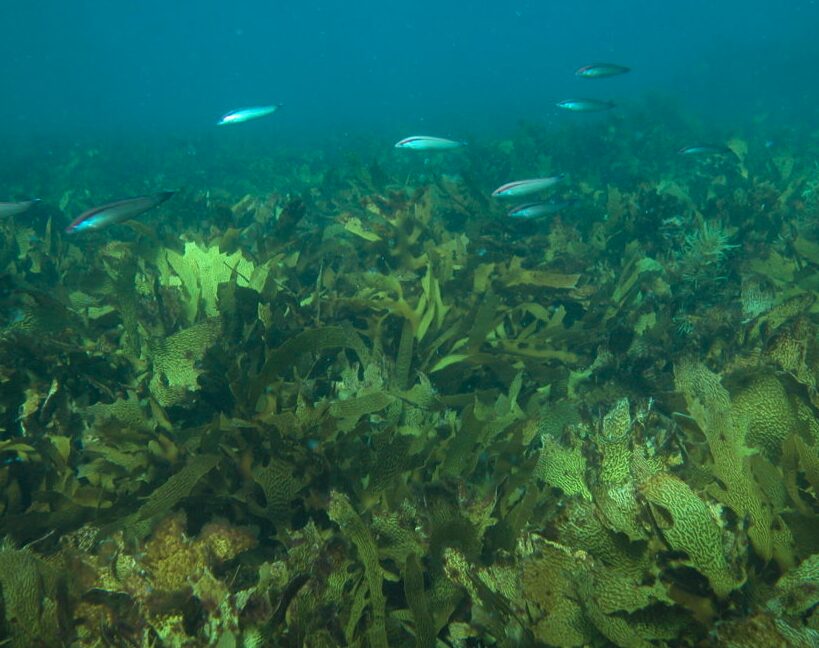
An international team of scientists, led by the NSW Department of Primary Industries and Regional Development (DPIRD), is working on a groundbreaking project designed to protect underwater kelp forests and sustain fisheries into the future.
The project is investigating how to boost the climate resilience of kelp forests to secure the future of these important marine habitats which are declining globally, including in NSW.
The research is part of the NSW Government’s Marine Estate Management Strategy 2018 – 2028, which outlines how to protect and enhance our waterways, coastline and estuaries over the next 10 years.
Kelp forests provide food, shelter and breeding grounds for thousands of marine species, absorb carbon dioxide, improve water quality and help buffer coastlines from storm impacts and erosion.
Researchers from DPIRD, Dr Melinda Coleman and Dr Hugh Goold, first aim to identify climate-tolerance traits in microalgae which are easier to study, have smaller genomes and faster generation times.
The learnings from these organisms can be translated to more complex, slower growing species like golden kelp (Ecklonia radiata).
“Kelp forests are often underappreciated but they’re just as important as our higher profile marine habitats, like coral reefs, but they are increasingly challenged by climate change in Australia and globally,” said Dr Coleman.
“To keep pace with climate change, we need to start investing in innovative and transformative technologies that will allow scientists to build climate resilience into kelp forests.
“It’s vital we share the data we gather so that these proactive conservation strategies can be applied to support other important marine habitats.”
The research team will then develop advanced gene-editing tools that can be used in the future to enhance beneficial traits, helping improve the resilience of these critical marine ecosystems under accelerating ocean warming.
While the project is focussed on improving marine ecosystems, the research could also help pinpoint the same climate-tolerance traits in agricultural crop plants.
“If we figure out the genetics underpinning how these organisms survive in warmer climates and apply that in restoration, we will be able to prepare our important marine habitats for climate change, and ensure value is retained by our stakeholders over coming generations,” said Dr Goold.
“We will develop cutting edge tools to genetically boost climate resilience in golden kelp and will guide managers and practitioners in understanding these approaches well before we need to deploy them — preparedness is central to protect fisheries and agriculture into the future.
“While this project is focussed on improving the marine environment, the data we generate and the strategies we develop will one day be able to improve agricultural food crop climate resilience and help tackle problem weeds.”
The project has received global interest and was selected for funding by Revive & Restore, a US-based wildlife conservation organisation which advances innovative biotechnology projects to tackle biodiversity loss.
“This project shows how our world-leading scientists are exploring the latest innovations in biotechnology to restore and conserve the state’s marine and coastal environments to sustain our fisheries into the future,” said Minister for Agriculture, Tara Moriarty.
“It is exciting to think that the data gained from this project could later be adapted to improve the climate resilience of agricultural crops, which are crucial for our state’s economy and the livelihoods of many farmers in regional NSW.”
The research will benefit from an expert team of collaborators from King Abdullah University of Science and Technology (Saudi Arabia), Laboratory of Microbial Biodiversity and Biotechnology at Banyuls-sur-Mer Oceanographic Observatory (France), and Flinders University (Australia).