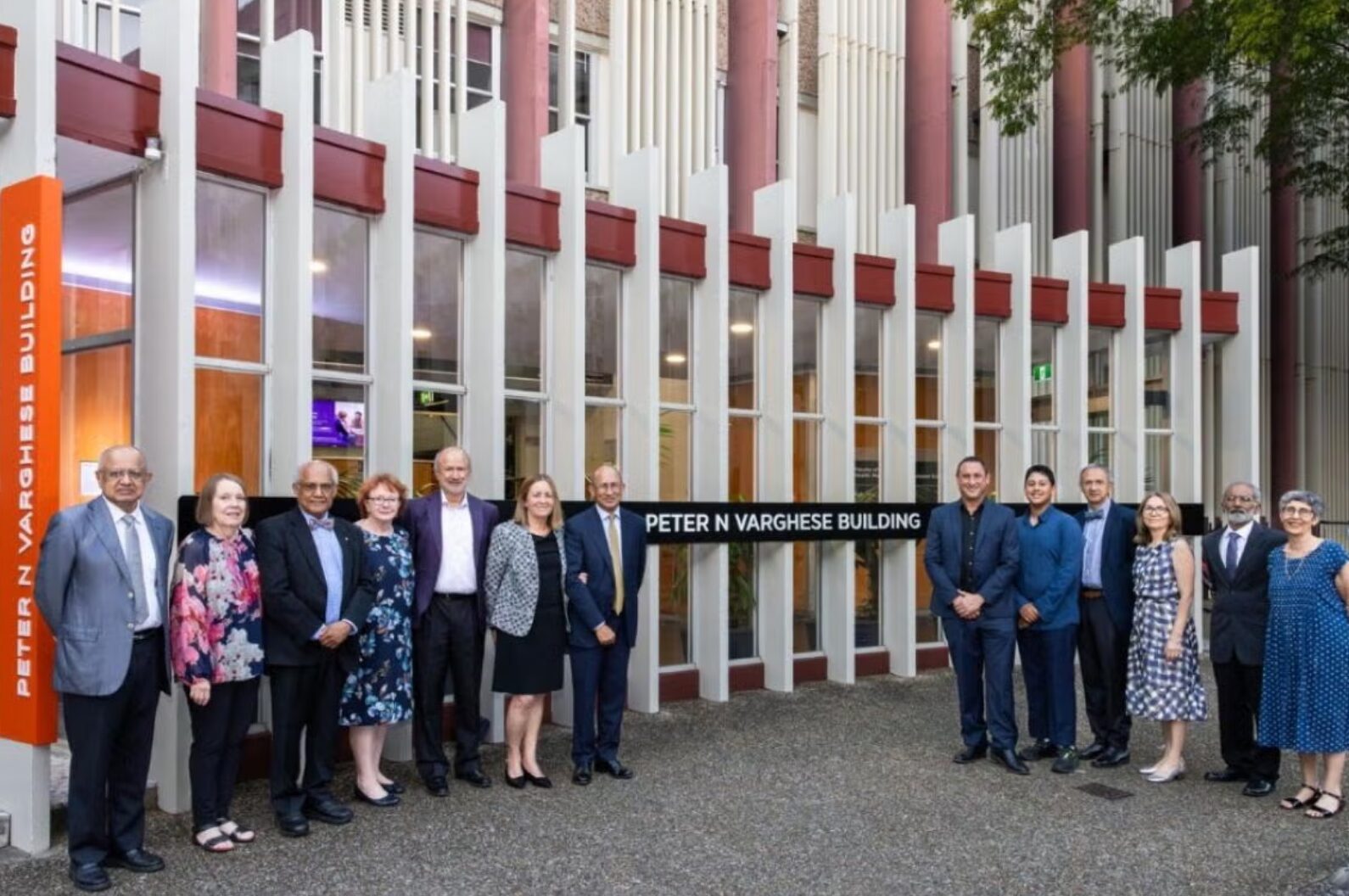
The University of Queensland has honoured the extraordinary contribution of former Chancellor Peter Varghese AO by naming a building in his honour on the campus that became a ‘second home’ to his family in the 1960s.
UQ’s Social Sciences Building at the St Lucia campus has been renamed the Peter N Varghese Building recognising his decade-long tenure as UQ’s 14th Chancellor.
Honorary Adjunct Professor Peter Varghese’s affinity with UQ began when his father accepted a lectureship in 1965 shortly after migrating from Kenya.
Mr Varghese and six of his siblings studied at UQ and he also met his wife Margaret on campus during their student days.
“It has been in many ways a typical story of migration success and the role of education in building careers and opportunities,” Mr Varghese said.

“My siblings have made major contributions in the field of medicine, especially psychiatry, as well as in science research, public service, social justice and university administration.
“The next generation is particularly strong in law.”
Vice-Chancellor Professor Deborah Terry AC said while Mr Varghese’s individual contribution was worthy of recognition in its own right, the naming was also a powerful reminder universities were never built by a single generation.
“Peter’s father spent many years teaching in the building, helping to prepare generations of Queensland educators,” Professor Terry said.

“In the same period, the St Lucia campus became a place of learning, opportunity and connection for the entire Varghese family.
“Universities are strengthened over time by countless contributions from all those who teach, study, lead, support and serve.”
Mr Varghese graduated from UQ with a Bachelor of Arts First Class Honours and a University medal in 1978 before working at Australia’s foreign service for 38 years where he became one of the nation’s most distinguished diplomats and Secretary of the Department of Foreign Affairs and Trade.
Although he had prior exposure to the international education sector, the 10 years as leader of the UQ Senate altered his perspective on universities’ role in society.
“It brought out for me in much sharper relief the breadth of the sector’s connections to the community, the partnership with business, the focus on the commercialisation of research and the global reach of UQ’s relationships,” he said.
Known for leading with the mantra ‘universities exist for a purpose larger than ourselves’, Mr Varghese said ensuring UQ delivered for Queenslanders was paramount.
“Barriers to education need to be overcome to ensure opportunity is available for all and this is why we developed The Queensland Commitment,” Mr Varghese said.
“I’m also proud to have helped establish UQ’s Future Fund, to protect the University from major financial shocks at the same time as supporting educational offerings.”
He drew on his international experience in the response to the COVID-19 pandemic and establishing research partnerships including the flagship collaboration with Indian Institute of Technology (IIT) Delhi.
“We were also the first university to impose an internal cap on the ratio of international to domestic students, reflecting our position that quality and integrity needed to be maintained and balanced with sustainable growth,” he said.
Mr Varghese said he was delighted UQ’s graduation ceremonies would return to Mayne Hall, where he accepted his certificate in 1978.

“The sense of joy and achievement at graduation and recognition of our outstanding alumni was always a special part of my role,” Mr Varghese said.
As a student, he spent endless hours debating the ‘big issues’ in the main refectory and always enjoyed The Great Court and riverside grounds.
“In my view, it’s the most beautiful campus in Australia,” he said.
While ‘dropping down a gear’ to write and travel, he remains connected to the University as an Adjunct Professor in the School of Political Science and International Studies.
He has also retained his role as chair of the Australian Public Policy Institute (APPI) and on the organising board for the T20 World Cup to be hosted by Australia and New Zealand in 2028.